
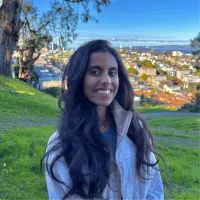
The author and her grandmother.
The Reality of Growing Old in America
I do not want to grow old in the society that exists today.
To be alive is to age, yet most humans are deeply uncomfortable with its final chapters. We eagerly document early milestones: our first steps, a tooth growing in, graduations, weddings. These beginnings feel tangible, full of promise and possibility.
But as life goes on, our milestones shift. Suddenly, it’s about marking losses: our hair, our mobility, our memory, our health. On television, elders are the butt of jokes. In lines at the grocery store, people outwardly sigh as impatience greets a slower pace. In hospitals and clinics, older adults are spoken to like children. Ageism, as they call it, is normalized.
My grandmother, Mamama, was an avid Sudoku player. I have fond memories of my family clustered around the dining table, working (and competing!) to do puzzles in the local newspaper. Our dining table was the center of most things. It was where Mamama led her Reiki sessions, where I did homework after school, where we gathered for meals, and, most importantly, the one spot in the house where you could see everything.
Sitting at the dining table meant you had a panoramic view of the backyard, the front yard, the kitchen, the living room, people running up and down the stairs, and guests coming in through the front door. My grandmother would spend most of her day sitting here, soaking in the noise, the scenery, the conversations, and the chaos around her. She had Lewy Body dementia and atypical Parkinson’s disease. My family and I were her caretakers.
Years into her disease, she would still reach for the newspaper, searching for the Sudoku or Wonderword. The puzzles were harder now, but she didn’t seem to notice. It was the act of writing, being in a space that felt familiar to her, using muscle memory to engage in something so stimulating.
Even as memory fades and bodies fail, life continues. What began as caring for one person I love has grown into a responsibility I feel toward many. There is value in supporting someone to stay at home, in comfortable spaces, surrounded by people and routines they know. But for many, life does not continue in this way.
Cognitive impairment is often treated as a justification for segregation. The United States largely relies on institutional memory care facilities, or “senior homes”, to care for elders. This practice reflects a carceral logic, isolating people with dementia from their communities under the guise of “safety”.
Scholars of critical gerontology describe this framework as abolition medicine: systems that claim to protect the vulnerable but, in fact, enforce confinement and control. Paired with the concept of debility, or the social and physical vulnerabilities that arise when infrastructures refuse to support people’s needs, especially as they grow old. The limits on elders’ lives often come not from disease itself, but from the structures we have normalized around disease.
The United States lags in developing interventions that support “aging in place”.
Let’s take the Netherlands, for example. They have constructed a neighborhood-style dementia village called De Hogeweyk, where residents live in lifestyle-matched homes, with a supermarket, garden, café, and theater, all staffed by caregivers. The caregivers are trained to provide dementia support services and dress in “street wear” to simulate normal living. De Hogeweyk has shown reduced use of antipsychotic medications and increased social engagement among dementia patients, highlighting the potential health benefits of maintaining care within familiar, communal networks.
In the United States, individuals living in senior homes have a 53% higher risk of death compared to those cared for at home. I have seen it firsthand: the neglect, the overcrowding, the uncalled-for anger from caregivers, and the minimal one-on-one attention. It’s not an individual failing. Most senior homes lack sufficient staff to provide high-quality care to patients. As a result, elders are isolated, mistreated, and harassed on the basis of non-compliance. We can do better.
Institutional senior homes are fundamentally the wrong model.
It is imperative that we rethink how care for older adults is structured in the United States. Senior homes place residents on rigid schedules, where any semblance of independence is lost. While elders may not have the capacity to live “independently,” it’s an argument of autonomy. Surveillance too often becomes confinement, draining our minds, bodies, and quality of life as we grow older. I don’t believe aging should be feared. Every stage of life asks something new of us, and the communities we build should rise to meet those needs.
Paula Carder, director of the Institute on Aging at Portland State University, claims, “The values of assisted living [tap] into what older people, and everybody wants: independence, joy, privacy and dignity…,” yet, too often, these values are lost in our country’s model of care.
The United States must adopt its own version of “De Hogeweyk” to establish a care ecosystem that supports independent living among older adults. Neighborhoods should be walkable and safe, with caregivers integrated into daily life as neighbors and community members rather than solely as medical personnel. It would be practical to redirect Medicare funding from traditional long-term care facilities to the development of dementia villages across the country.
It’s tempting to see aging and cognitive decline as problems to be managed behind locked doors, as though life slows to a halt once independence wanes. But our community needs to invest in the older population. Prioritizing dementia-friendly communities would ease the strain on families, reshape the spaces elders move through every day, and reaffirm the beauty in growing old.
Some may worry that dementia villages are messy, costly, or difficult to scale. But the greater risk lies in the alternative: a society that treats decline as containment. Growing old should mean living comfortably, fully in view of the world — surrounded by community, choice, and life, not hidden away, confined, or made invisible.


